Beginner Guide
Quest-Life Balance in Ledgerbound: Relationships, Tactics, and Time Choices
How Ledgerbound's official premise frames limited time between relationships and tactical improvement—and how to make spoiler-safe, version-aware choices.
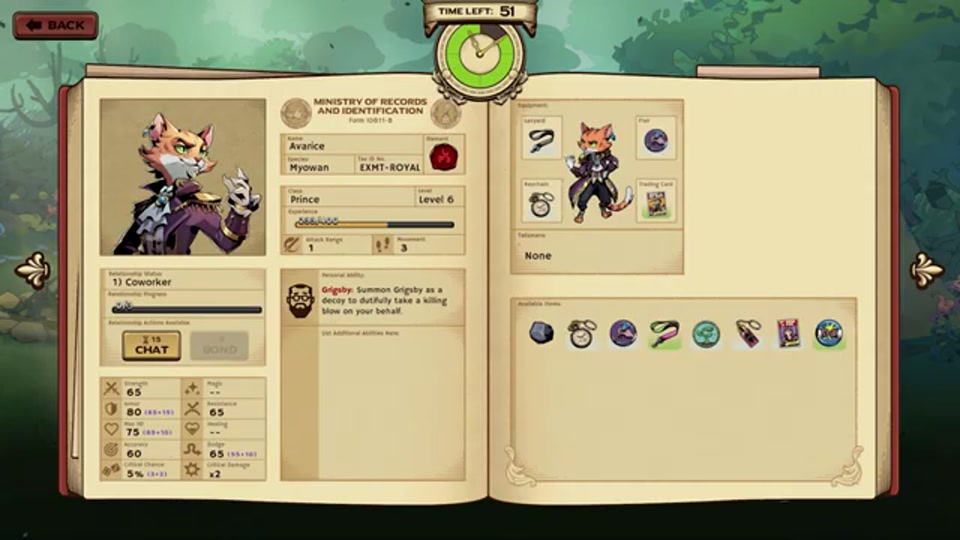
The phrase quest-life balance is part of Ledgerbound’s official public voice. The Steam description asks whether you will spend limited evenings nurturing relationships or burn the midnight oil to improve as a tactician and move closer to a promotion. That is a clear invitation to think about priorities. It is not a published spreadsheet of exact time costs, a universal romance timetable, or a proof that one choice always locks another. This guide turns the premise into a practical, spoiler-safe decision method rather than an invented optimization route.
The public premise: time is limited
The official store copy explicitly frames time as limited and sets up a tension between social life and tactical improvement. The final-demo announcement also calls out Burn Out, camp conversations, newsletters, and difficulty settings. Together, these sources establish that pacing, personal connection, and player priorities are part of the game’s public identity. They do not disclose every trigger, point value, or route consequence.
That is enough to support a helpful beginner principle: decide what you want from a session before you try to optimize it. If you are excited to know a coworker better, give that interaction your attention. If a tactical encounter is teaching you something, leave room to reflect on it. If the game shows a visible cost or outcome, read it in the release version rather than assuming a preview-era guide has the same rules.
There is no universal “correct” evening
A common mistake in relationship-focused games is treating every social choice as a test with one right answer. The official premise instead highlights a trade-off. That means the better question is not “what does the internet say I must do?” but “what do I want this playthrough to emphasize?” Story curiosity, tactical mastery, completion, and a low-pressure first run are all legitimate goals. They can lead to different decisions without any one player being wrong.
Avoid copying an alleged optimal schedule if it does not name the version, the difficulty setting, and the result it is trying to achieve. An older demo build may have different balance, interface, or available conversations. A player who rushed through dialogue for an efficient clear may offer bad advice to someone who cares most about character writing. Advice is only useful when it names the problem it solves.
Start with your own priority
Before a mission or downtime period, choose a short priority statement. “I want to learn this battle,” “I want a story-forward session,” or “I want to test a visible mechanic” is enough. It gives you a baseline for judging a decision later. If you change your mind, that is fine; you will at least know why you changed rather than feeling that every choice has hidden, unknowable stakes.
This is particularly helpful when a game blends tactics and relationships. An encounter can be intellectually satisfying but take more concentration than you have after work. A conversation can be emotionally rich but not be the right fit when you want to focus on strategy. Quest-life balance is not only a fictional joke—it can be a useful reminder to play in a way that fits your real available attention.
Read visible consequences closely
The Steam description says choices matter and that decisions stick. That is a strong tone and design signal, but it does not tell us the exact scope of every choice. When the released game provides a warning, tooltip, or explicit consequence, use that information. When it does not, avoid treating an online theory as a guarantee. A character’s reaction may carry narrative meaning without being a hidden relationship score, and a tactical loss may be recoverable without proving a route has ended.
If you need help, ask a bounded question: “Does this visible choice close content immediately?” or “Can I revisit this activity later?” Give your current chapter and the spoiler limit you want. A thoughtful answer can then explain what is known without revealing a later relationship scene or final outcome.
Burn Out and pressure management
The final demo explicitly highlighted a Burn Out mechanic and asked for feedback on time and burnout. That tells us the developer considered pressure and pacing worthy of discussion. It does not establish a fixed formula. Do not claim that a certain number of actions, conversations, or missions always produces a particular state unless the current game displays that rule and a guide records the version.
Our Burn Out guide explains the same evidence boundary in more detail. The practical approach is simple: read the current in-game explanation, test one factor at a time, and use normal save or replay tools if available. Do not force-quit or alter files to discover a supposed optimal path; that can create a technical issue rather than useful knowledge.
Relationships without route spoilers
The launch material presents relationship building as part of the experience, and the official romance announcement introduces eligible characters. It does not make every conversation a romance lock or every named character a route guarantee. Let the game introduce people at its own pace. If you recognize an actor or character, our confirmed cast guide can give you public information without turning a first encounter into a checklist.
If a particular character interests you, read their basic profile only if you want the confirmed promotional context. For example, Cazian’s official romance-cast announcement supports his public role and Ben Starr’s credit, but it does not require you to read an ending or memorise a dialogue plan. Story discovery is a valid goal.
Tactics without turning play into homework
Tactical improvement is most durable when it comes from observing the current encounter. Read the objective, inspect the information the game gives you, and change one variable after a loss. Do not assume a character needs a particular build because an old clip says so. The game’s first hotfix demonstrates why: early release versions can have battle fixes, audio changes, and known issues that alter the practical context of advice.
When a technical problem appears, separate it from a strategic challenge. A repeatable crash or load loop needs patch information and a clear report; an encounter you have not yet solved needs a plan and perhaps practice. Our Patch #1 guide covers the official hotfix scope and the documented battle-reset option for its named save issue.
A balanced first-playthrough routine
Try a rhythm that alternates attention rather than imposing an invented percentage. After a demanding encounter, take time to read a social scene if you are interested. After a dense story section, review a tutorial or test a tactic if you want more control. Stop at a natural point when you are tired instead of pushing through a choice you will not remember. This is not a secret in-game strategy; it is a humane way to enjoy a game whose theme explicitly plays with work, time, and pressure.
If your goal is completion later, you can use a separate, clearly versioned guide with the spoiler level you choose. Your first playthrough does not need to become a second job. The public premise itself suggests that “saving the world” and healthy priorities are in conversation with each other.
Bottom line
Quest-life balance is the official framing for a limited-time choice between relationships and tactical improvement. It is not proof of a universal schedule. Read current visible rules, choose a priority for your own run, and seek narrowly scoped help when you need it. That approach respects both the game’s relationships and its tactical side without sacrificing a first-playthrough surprise to stale optimization advice.
Frequently Asked Questions
What is quest-life balance in Ledgerbound?
The official store description uses the phrase to frame the tension between relationship time and improving as a tactician; it should not be treated as a published numerical system without current evidence.
Should I focus on relationships or tactics first?
Choose according to your goal for the current playthrough and read the game’s current text. This guide does not claim a universal optimal schedule.
Are relationship choices permanent?
The store description says choices matter and players are stuck with each decision forever, but route-specific effects should be verified in the current game before relying on a checklist.