Protagonist
Rayna
The Reluctant Adjuster
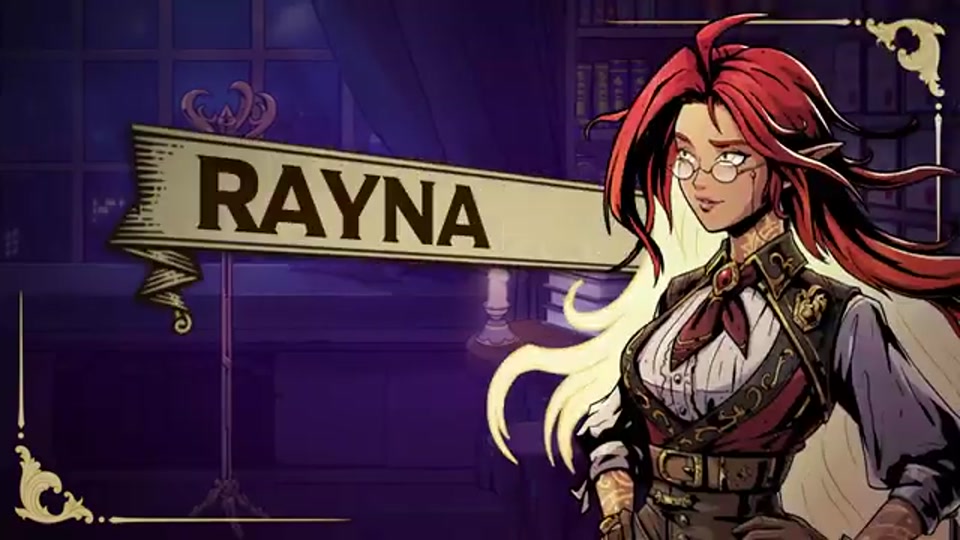
“This is well outside the scope of my role.”
Rayna is the protagonist at the center of Ledgerbound’s public premise. The developer’s cast announcement credits Heather Gonzalez as Rayna, while the launch description frames the game as a narrative-driven tactical RPG and dating sim built around a corporate-fantasy world. Public material also presents Rayna as an insurance adjuster pulled into a much larger crisis. Those are strong starting facts. They are not a licence to invent a full biography, final route, combat build, or personal motivation that the game has not explicitly revealed.
What is confirmed about Rayna
Rayna is the player’s central character in the published premise, and Heather Gonzalez is the officially announced voice performer. The ordinary-professional starting point is important because it explains the game’s unusual tone. The story does not introduce its hero only through a royal bloodline, military rank, or ancient prophecy. It introduces an employee whose work vocabulary belongs to insurance and administration, then puts that vocabulary next to fantasy-scale stakes.
That contrast is a foundation for the humor, but it should not flatten Rayna into a single joke. “Insurance adjuster” tells us something about the premise and the institutional lens of the world. It does not prove every opinion Rayna holds, every choice she makes, or how a player will interpret a scene. As the protagonist, she is also the point through which a player discovers the setting. A basic profile should leave room for that discovery.
A protagonist shaped by the corporate-fantasy premise
The official launch material describes Ledgerbound through tactical challenges, relationships, and a workplace-inflected fantasy world. Rayna sits where those ideas meet. Her job background makes the game’s administrative language feel personal: forms, policies, claims, company expectations, and the absurdity of treating a crisis as a professional assignment all have more weight when the central character is an employee rather than a detached observer.
This is an interpretation of the published premise, not an assertion that every scene follows the same pattern. A good character guide names the lens without spoiling the plot. It can tell a newcomer that the game is interested in work, institutions, and relationships; it should not announce which coworkers betray whom, what an alleged “correct” dialogue choice does, or whether a late story event changes Rayna’s role. Those claims need direct support and a prominent spoiler warning.
Heather Gonzalez’s credit
The official cast announcement pairs Heather Gonzalez with Rayna. A voice credit is valuable information for players who recognize a performer, care about voice work, or are researching the creative team. It also has a precise scope. It confirms the performer-character pairing; it does not establish the amount of dialogue, the exact version of every line, or the availability of a particular scene.
The first launch hotfix mentions Prologue voice-over timing adjustments. That is an example of why readers should not confuse an audio update with a cast change. A timing fix can affect presentation while the performer credit remains the same. For current technical context, see our Patch #1 guide. For the full list of confirmed public credits, see Ledgerbound voice cast and confirmed characters.
Playing Rayna without reading a route guide first
If you are beginning a first playthrough, let the early game establish Rayna’s voice and priorities through the dialogue in front of you. A character page can help with names and credits, but it should not replace your own reading of the performance. Pay attention to who is speaking, what an institutional demand asks of her, and how the game frames the decision. That approach is more reliable than importing a fan description that may be based on a different branch or a late-game reveal.
When you choose an option, do not assume an online phrase such as “best Rayna build” or “true personality choice” is canonical. In player-driven stories, a preference is often exactly that: a preference. If the game visibly explains a consequence, use the text it provides. If it does not, resist the impulse to turn a rumor into a rule. You can always return to spoiler-marked material later if your goal changes from discovery to completion.
Tactical claims require a current source
Rayna is the protagonist, but that alone does not prove a particular combat role, element, ability, or mandatory party composition. Old preview articles may describe systems that changed before release, and a player clip may show a build that only works under specific conditions. This profile will not claim a “best” loadout until there is current, reproducible evidence and the advice can name the version it tested.
The safest early practice is to read the current in-game tutorial, inspect the tool tips that apply to the mission you are playing, and make one change at a time when an encounter is difficult. That method respects the released game rather than a guide writer’s assumptions. It also protects the profile from becoming a pile of stale numbers after a balance update.
For a wider look at the public premise, use the Eldarra and Bureaucratic Society guide. For a version-aware introduction to pressure and pacing, use the Burn Out guide. Both pages keep their claims within what their official sources establish.
Relationships and spoilers
The launch material says the game includes relationship elements, but a character being central to the story does not confirm every possible relationship outcome. A romance guide should identify its evidence, version, and spoiler boundary. It should not use a character’s popularity, voice actor, or a vague promotional sentence as a substitute for route documentation. The same goes for terms like “permanent choice” and “ending”: they have specific gameplay meanings that must be proved, not assumed.
This page stays spoiler-light by design. It gives a new player enough context to recognize why Rayna matters to the game without deciding how she should be played or what she becomes. If you want to explore the ensemble, begin with the cast guide and the official announcements it links; if you want a blind first run, return after you have reached a natural story stopping point.
How this profile will be maintained
We will add a character detail only when it has a clear source: official game text, an official announcement, a credit, or a directly verifiable current-game observation that is appropriately labelled. We will correct claims when a newer source supersedes an older one. We will not scrape private data, treat a leak as canon, or copy a community theory into the “facts” box because it reads smoothly.
That standard makes the page slightly less encyclopedic today, but much more useful over time. It tells a reader what is known, what is merely inferred from tone, and what belongs to their own playthrough. Rayna’s appeal begins with the collision between ordinary professional life and extraordinary stakes; the point of playing is to see how that collision unfolds rather than have a profile resolve it in advance.