Overview
Eldarra and the Bureaucratic Society: Ledgerbound's Setting Explained
A spoiler-conscious explanation of Eldarra, the Bureaucratic Society, and the corporate-fantasy premise, grounded in OmniMegaSuperCorp's official lore post.
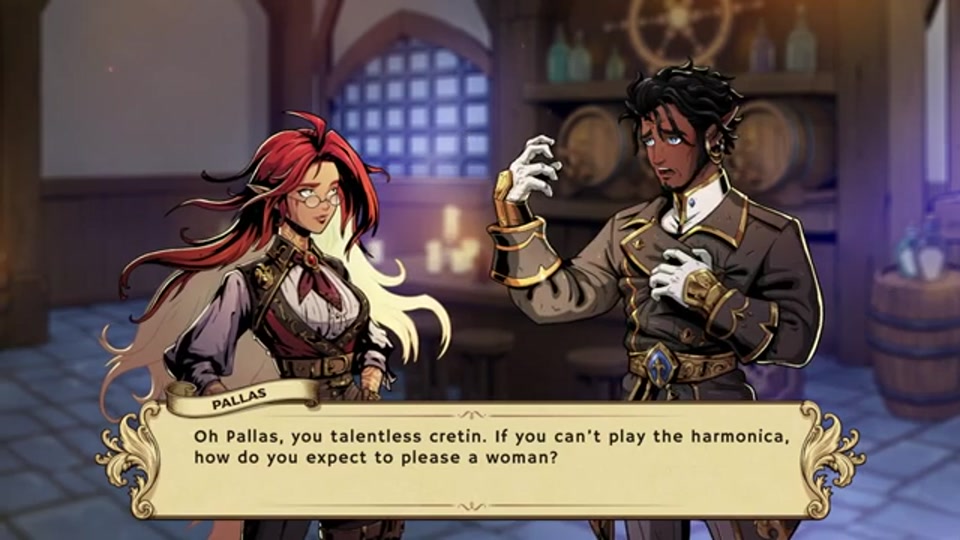
Ledgerbound uses a deliberately odd combination of fantasy adventure and office life. Its setting, Eldarra, is not presented as a generic kingdom with modern jokes pasted on top. The public material instead makes administrative language, insurance work, workplace relationships, and institutional absurdity part of the game’s identity. That approach can make a first description sound confusing: is it a tactical RPG, a dating sim, a work comedy, or a fantasy story? The official launch description calls it a narrative-driven tactical RPG and dating sim. The better answer is that the corporate premise is the lens through which its fantasy world is introduced.
This page is a reader’s orientation, not a substitute for discovering the story. It relies on OmniMegaSuperCorp’s official Bureaucratic Society lore post and launch materials. Where the game leaves room for interpretation, we say so. We do not convert a name, a tonal joke, or a community theory into a claimed fact about hidden history, endings, or romance routes.
Eldarra: a fantasy world with institutional stakes
The name Eldarra identifies the world of Ledgerbound. In the public framing, its fantasy atmosphere exists alongside a distinctly bureaucratic structure. The player’s work is not merely a contemporary-office parody detached from the plot; paperwork, claims, departments, and professional obligations are part of the fiction’s vocabulary. That is why the marketing can make room for both tactical combat and questions that sound like workplace administration.
For a new player, the useful takeaway is tonal rather than encyclopedic. Expect characters and conflicts to be described through an employer’s language as well as through fantasy language. A task may be framed as an assignment, a threat may be seen through the consequences of a claim, and a relationship may develop within the social pressures of a workplace. None of that means every joke is disposable. In a good corporate satire, the paperwork is often how the story reveals who has power, who bears risk, and who is asked to solve an impossible problem.
It is tempting to fill the gaps with familiar genre assumptions: every office must be secretly evil, every department must be a faction, and every official title must hide a villain. The available official material does not authorize those sweeping conclusions. Let the game establish what individual groups and characters want. A spoiler-conscious guide should prepare you to notice the institutional theme without pre-writing a moral verdict for the story.
The Bureaucratic Society in the official lore post
OmniMegaSuperCorp published a Steam news post devoted to lore, history, and the Bureaucratic Society. The existence of that post is important evidence that the setting’s bureaucracy is more than a one-line marketing gag. It gives players a public entry point into historical context before they encounter every detail in game. It also establishes the Society as a named part of the setting’s background.
At the same time, “has an official lore post” is not permission to invent a complete chronology. The safest way to use it is to read it as an authored piece of worldbuilding, then separate direct statements from inferences. A direct statement can support a guide’s description of the Society as an in-world historical subject. An inference might be that the developers want institutions, rules, and professional language to matter thematically. An unsupported leap would be claiming the Society controls a particular ending, character route, or gameplay reward when no official source says that.
That distinction may sound academic, but it helps players. Long story games attract searches such as “what is the Bureaucratic Society,” “is this faction good,” and “does this choice affect the ending.” Search results that confidently answer the last two without a cited walkthrough can spoil or mislead. This page deliberately answers the first question at a high level and directs readers to the official post for the published lore rather than pretending to provide a definitive plot map.
Why bureaucracy fits a tactical role-playing game
The game’s official launch copy connects narrative, tactical battles, and relationships. The office-and-insurance framing provides a shared language for those different activities. A battle can have consequences beyond winning a field; a conversation can be colored by professional standing; and an apparently mundane decision can become comic because it is taking place in a world where fantasy-scale problems receive procedural treatment.
This is a reading of the premise, not a mechanical claim. We are not saying that every battle changes a relationship score, that every dialogue option changes a claim, or that a particular department produces a particular combat effect. The official sources cited here do not document those exact rules. Instead, the premise helps explain why a game can combine the vocabulary of magical adventure with the vocabulary of forms, meetings, and organizational hierarchy without treating either half as accidental.
For players who enjoy fiction such as workplace comedies, legal dramas, or political fantasy, the setting may be appealing precisely because it makes systems personal. A policy can create friction between coworkers. A procedure can be both a joke and an obstacle. A formal title can signal status while leaving room for the character behind it to surprise you. The point is not that rules always defeat people; it is that people have to navigate rules while trying to do their jobs and sustain their relationships.
How to approach the setting on a first playthrough
Read the terminology before rushing to decode it. When a new institution, title, or historical reference appears, note the exact wording and the speaker. Is it a public fact, a company line, a personal complaint, or a joke? Those categories often carry different weight in satirical stories. An employee explaining a policy may be repeating it rather than endorsing it. A manager’s language may tell you as much about the organization as about the literal event.
Avoid searching for late-game answers as soon as you meet a name. It is fine to use a non-spoiler glossary like this one to establish the broad premise. It is less helpful to read a theory thread that asserts motives, route conditions, or outcome flags without citations. If you do seek help, state where you are in the game and ask for a spoiler boundary. That allows another player to explain a term without collapsing the mystery that the story is building.
Also keep an eye on version context. The setting itself is not likely to change with each hotfix, but a guide can accidentally combine lore with launch-build gameplay advice. For technical issues or current limitations, use our Patch #1 known-issues guide and the newest official Steam announcement. For release history, see the August 13 launch timeline.
A source-first glossary habit
When expanding this site’s lore coverage, we use a simple hierarchy. Official game text, the developer’s Steam announcements, and the Steam store description are the starting point. A full review can add a critic’s interpretation, clearly attributed as opinion. Community discussion can identify a question worth investigating, but it is not evidence by itself. Datamined or leaked material is not used as a source for published plot claims.
Readers can apply the same method. Look for a primary source, check its date, and ask what it actually establishes. Does it confirm that a group exists? Does it describe an event? Or is it simply a marketing sentence that establishes tone? The answer may still be useful, but different kinds of statements support different kinds of guides. This is especially valuable for a game whose comedy encourages deliberately official-sounding language.
Where to go next
If the setting has drawn you in, begin with the official lore post linked in the sources section and then experience the early game without reading route or ending guides. Our story and setting overview offers a second, high-level starting point; it should be read as an overview rather than a canonical encyclopedia. If you are here because a specific scene or battle is blocking progress, look for a version-dated guide and compare it with the latest patch notes.
The most accurate short definition is therefore modest: Eldarra is Ledgerbound’s fantasy world, and the Bureaucratic Society is a named element of its published lore and historical framing. The corporate language is central to the game’s tone and premise. The deeper meaning of its institutions, and the consequences they have for individual characters, are things the game is designed for you to discover rather than a set of claims a guide should spoil in advance.
Frequently Asked Questions
What is Eldarra in Ledgerbound?
Eldarra is the fantasy world in which Ledgerbound is set. The official premise frames its institutions and conflicts through workplace and insurance satire.
What is the Bureaucratic Society?
The Bureaucratic Society is a historical organization described in the developer's official lore post. This guide limits its claims to that published material and avoids treating fan theories as canon.
Does this guide contain story spoilers?
It covers the public setting premise and official pre-release lore context, not late-game plot revelations, route outcomes, or unannounced character information.