Systems Guide
Ledgerbound Companions and Romance: A Spoiler-Conscious Guide
What Ledgerbound's official material confirms about relationships, eligible characters, and the cast—without inventing a route chart or a universal romance schedule.
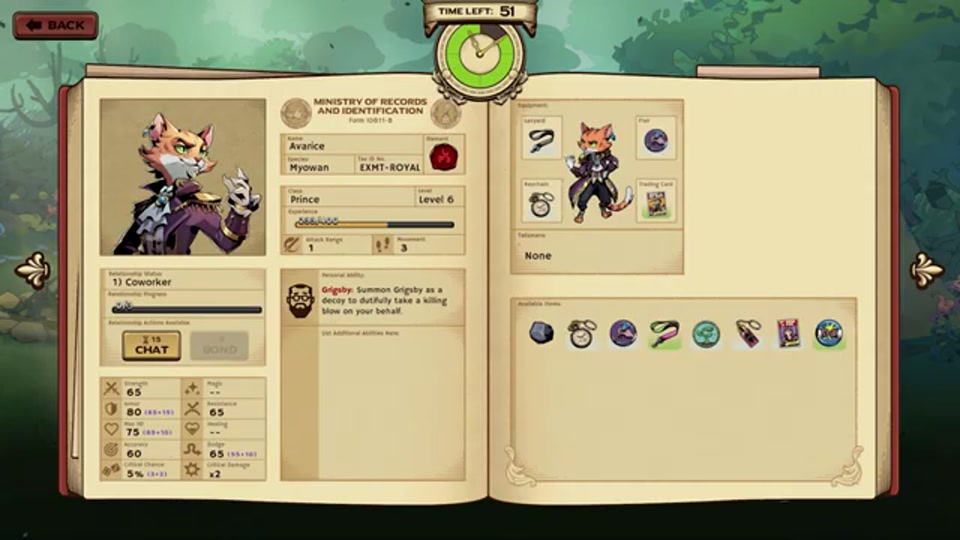
Ledgerbound publicly presents itself as a dating sim as well as a narrative-driven tactical RPG. OmniMegaSuperCorp’s romance-cast announcement introduces eligible bachelors and bachelorettes, while the Steam store description says players can befriend or fall in love with a ragtag group of heroes. Those statements establish that relationships matter to the game’s premise. They do not publish a complete route map, a universal optimal schedule, or an exhaustive list of every scene and consequence. This guide helps you use the confirmed information without sacrificing your first playthrough to outdated or invented advice.
What official material confirms
The official romance announcement names Prince Avarice, Cazian, Jazz, Etheria, Astros, and Pallas in its eligible-character presentation. It supplies performer credits for those promotional introductions: Matt Mercer as Prince Avarice, Ben Starr as Cazian, Stephanie Kerbis as Jazz, Caitlyn Elizabeth as Etheria, Gabriel Michael as Astros, and Delbert Hunt as Pallas. This is useful source-backed cast information.
It is not a complete gameplay contract. A promotional romance reveal does not tell us every eligibility condition, whether all players encounter the same sequence, how long a route takes, or what each relationship concludes with. Do not turn a cast announcement into a “best answer” guide. A character’s presence in a romantic promo confirms a public relationship role; the released game must supply the scene-specific details.
The wider announced cast
The developer’s separate voice-cast announcement credits Heather Gonzalez as Rayna, Todd Haberkorn as Hobknob, Stephanie Kerbis as Jazz, Matt Mercer as Prince Avarice, Cherami Leigh as Sylvie, Shelby Young as Joy, and Delbert Hunt as Pallas. Some names appear across the promotional material because casting, relationships, and story ensemble overlap. That overlap does not prove that every character has the same mechanical role or relationship availability.
Our voice-cast and confirmed characters guide keeps the full public credit list in one place. Individual profiles such as Cazian, Jazz, and Prince Avarice are intentionally spoiler-light. Use them to confirm names and actors, not to pre-read an outcome.
Relationships are not a universal checklist
The Steam page says that choices matter and that each decision leaves you stuck with it. That supports taking conversations seriously. It does not establish that every line hides a romance lock, that agreement is always best, or that a relationship can be reduced to a numerical score. A scene may be about friendship, conflict, comedy, or character development without being a permanent route test.
The best first-run practice is to read the context. Who is speaking? What are they asking? What has just happened? Does the current game give you a visible warning or consequence? If it does, use that information. If it does not, do not let an unattributed online chart take precedence over the story in front of you.
Choose your own relationship goal
There is no need to pursue a route simply because it is popular or because you like the actor. You may want to follow the character who interests you, see a friendship develop, play Rayna with a particular perspective, or leave romance for a future run. All are valid. The official premise offers choices; it does not require every player to optimize the same outcome.
Before making a significant decision, ask what you want from this playthrough. If the answer is “a spoiler-free story,” avoid a guide that lists endings. If it is “a specific relationship,” look for a guide that explicitly names its version and spoiler scope. If it is “I just want to know whether this character is publicly announced,” the official sources above are enough.
Quest-life balance and limited time
The store description frames limited time as a choice between relationships and improving as a tactician. The final-demo post also mentions camp conversations and Burn Out. This is a strong thematic and structural signal, but it is not a published calendar with fixed costs. Do not claim that a particular evening, conversation, or mission always guarantees a particular result unless the current game visibly says so and the guide identifies its build.
Our quest-life balance guide offers a practical approach: choose a goal for a session, read visible information, and avoid treating a demo-era schedule as a permanent law. A first run is allowed to contain trade-offs. That is part of the game’s premise, not a failure of planning.
Asking for romance help without spoilers
State your boundary when asking a question. “Can this present choice immediately lock content?” is a small, useful question. “Which ending is best?” is a request for major story information. Give your current chapter, platform, version, and desired level of detail. A helpful person can then answer what you need rather than collapsing an entire relationship arc into one reply.
Evaluate answers for evidence. A strong answer names the current condition it observed and distinguishes fact from preference. A weak answer claims that one option is always correct but cannot explain the version, route state, or source. Repetition across social posts does not make an unsupported claim official.
Separate relationship choices from technical issues
If a scene fails to progress because of a crash, missing audio, or a save problem, that is not a romance puzzle. Check current official patch notes and report the technical context. The first hotfix includes Prologue voice-over timing adjustments and documents specific battle-related issues. It is useful evidence for version status, not a relationship route guide. See Patch #1 known issues for the official scope.
Keeping these categories apart prevents a common bad conclusion: “my relationship choice broke the game.” A storyline surprise, a difficult decision, and a technical failure need different kinds of help.
Companions and combat claims
The official store says players build and manage a team, but a romance announcement does not identify every party role, element, weapon, or optimal lineup. Avoid using a character’s marketing position as proof of a particular combat build. Current tooltips, mission objectives, and version-labelled testing should determine tactical advice. Our tactical puzzle approach gives a source-conscious method for learning encounters without a stale tier list.
This also leaves room to play favorites. You may care about a character’s writing more than a temporary tactical preference, or vice versa. A guide can explain a trade-off without pretending a cast member is objectively useless or mandatory.
Bottom line
Relationships and romance are confirmed parts of Ledgerbound’s public identity, and the developer has introduced a named eligible cast with voice performers. Use those facts as a spoiler-light starting point. Let the current game define the scenes and conditions you encounter, ask bounded questions when you need help, and reserve full route charts for the moment you consciously choose spoilers. That is the safest way to enjoy both the cast and the tactical side of the game.
Frequently Asked Questions
Can you romance characters in Ledgerbound?
Yes. The official store presentation identifies Ledgerbound as a dating sim, and the developer's romance announcement introduces eligible characters. Exact route conditions require current, source-labelled evidence.
Who can you romance in Ledgerbound?
Official romance promotion names Prince Avarice, Cazian, Jazz, Etheria, Astros, and Pallas. Treat that as a public cast introduction, not a complete walkthrough or a guarantee of identical route outcomes.
Do romance choices affect the game?
The official store description says choices matter and decisions stick. It does not publish a full map of each relationship consequence, so read current game text and use spoiler-labelled help when needed.