News
Ledgerbound's Steam Review Delay Ended With an August 13 Launch
Ledgerbound's planned August 11 launch paused for Steam review, then received approval and launched on August 13 at 8am PT.
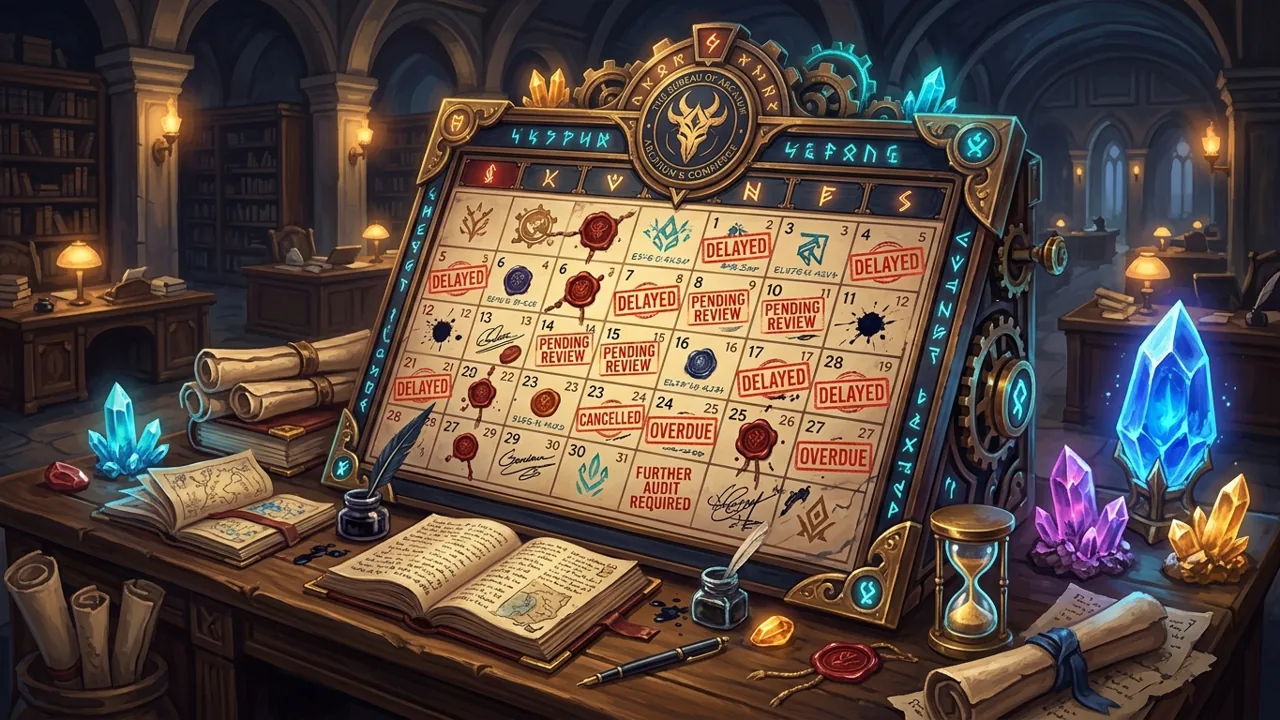
Update, August 15: The temporary Steam-review delay described in the original version of this article ended quickly. Steam approved Ledgerbound, and OmniMegaSuperCorp announced an August 13, 2026 launch at 8am PT. The game is now available on Steam. This page preserves the short delay as release history and links to the developer’s official updates rather than treating pre-launch reports as current information.
What happened between August 11 and August 13
Ledgerbound had already moved once from its original July 14 date to August 11. On the planned August 11 launch day, OmniMegaSuperCorp posted an in-character Steam announcement saying the game was waiting for Steam’s final approval. The developer said the build was ready, but that the platform was reviewing the game’s roughly 350,000 words of text.
That number is useful context, but it should not be treated as a promise about playtime, branching-path counts, or the amount of romance content. It is a figure from the developer’s announcement about the approval process. The same post was later updated to say that Steam had approved the game and that the launch would happen on August 13 at 8am Pacific time.
The official launch post then confirmed that Ledgerbound was available. That sequence matters because older articles, search snippets, and cached store pages may still show July 14 or August 11. For current availability, use the Steam store page; for the site’s maintained overview, see our release date and platforms guide.
Why the delay was not a new development delay
The word delay can describe several very different situations. A production delay usually means the developer needs additional time to make or test the game. The August 11 update described a different situation: OmniMegaSuperCorp said the game was complete and awaiting a platform-review decision. The approval update followed within the same announcement, with a specific launch time two days later.
That distinction is especially important for anyone researching the game after the fact. It would be misleading to describe the August 11 event as evidence that the team cut content, changed the roadmap, or postponed the game indefinitely. The official statements only establish that Steam’s final review temporarily held up the release and that approval was subsequently granted. They do not establish a wider development problem.
The company understandably framed the announcement through the game’s corporate comedy: paperwork, a fictional HR representative, and a joke about the game’s employees being a metaphorical family. That voice is part of the marketing, but the underlying practical information is simple: the August 11 target did not happen, and the released version arrived on August 13.
What the official launch announcement confirms
The launch post describes Ledgerbound as a narrative-driven tactical RPG and dating sim. It reiterates the game’s central loop: take on tactical battles, manage the corporate-fantasy world around them, and build relationships with coworkers. Those are safe high-level descriptions because they come directly from the developer’s announcement and Steam listing.
The same post highlights several review excerpts and scores selected by the developer. Those links are helpful starting points for readers who want criticism or buying advice, but they are not a substitute for independent consensus. A launch announcement naturally curates positive pull quotes. When evaluating the game, read the full reviews, check the current Steam user-review summary, and separate a reviewer’s opinion from a documented feature.
The launch announcement also says that a Deluxe Supporter Edition is available. According to the developer, it includes cosmetic rewards, a digital soundtrack, and other supporter extras. Its description mentions a cosmetic skin for Rayna’s hat rack. Treat it as optional support content rather than a source of gameplay advantages unless the store’s current DLC page explicitly states otherwise.
Finally, the developer announced that the soundtrack contains more than forty tracks by composer Diego Chi and is available on digital streaming platforms. That is a useful companion detail for fans of the game’s music, but it should not be confused with an in-game feature or a required purchase.
The first hotfix arrived quickly
The first post-launch patch is the best sign that the live game, rather than an old demo build, should now guide the site’s strategy coverage. The official hotfix lists audio adjustments, Prologue voice-over timing changes, and several battle fixes. It also addresses freezes after certain victories, a problem in the lower half of the Emberworks battle, a reload problem in the Landfill battle with wounded casters, and a possible issue after the Consume Rift ability in Elderhold.
The patch notes also name several known issues: no support for super-ultrawide or windowed mode, no way to dismiss summons, a possible autosave crash/reload loop, the balance of Uninsured Difficulty, and the lack of a chat log. Players affected by the battle-save issue are directed to the Reset Battle button in the title-screen settings. That is practical, source-backed troubleshooting information; it is more useful than repeating pre-release speculation about mechanics that may have changed before launch.
What this means for our coverage
This site is shifting from preview coverage to version-aware guides. Older news is still useful as a record of announcements, trailers, and the two release-date changes. It should not be used to infer current prices, platform availability, balance values, character routes, or technical support.
We will use official patch notes as the source of truth for live-game fixes and label any mechanics that still need direct verification. If you are deciding whether to buy, start with the current Steam page and reviews published after the August 13 launch. If you have already started playing, see the Patch #1 known-issues and troubleshooting guide before assuming a stalled battle or an odd audio cue is permanent. For a broader orientation, our beginner guide separates evergreen onboarding advice from details that can change with patches.
A careful way to read launch-week information
Launch-week reporting is unusually prone to stale facts. Previews may describe a demo build, a store page can be cached before its release state changes, and a social post can be correct when published but incomplete a few hours later. The responsible approach is to attach each claim to a date and a source. In this case, the developer’s August 11 announcement establishes the temporary review hold; its approval update establishes the revised launch time; the August 13 announcement establishes that the game was out; and the August 14 hotfix establishes that the team was already publishing post-launch fixes. Each document answers a different question.
This also gives readers a useful order of operations. First, check whether the game is currently available on the store page. Next, read the newest official patch note for issues that could affect a purchase or a save. Then use previews and reviews for interpretation, clearly recognizing that they are opinions or observations rather than product documentation. A page that lists those materials together should not quietly turn a reviewer’s impression into a confirmed system rule.
We will continue to correct this archive when a primary source supersedes a time-sensitive statement. That is not a retroactive rewrite of the news cycle: it is a way to preserve the original event while keeping a player-facing guide from directing someone toward an obsolete date. Readers who find a discrepancy can use the linked Steam announcements at the top of this page to check the underlying record themselves. PC system requirements guide and the combat system overview for context, while checking the latest patch notes for changes that affect your build or save.