Overview
Ledgerbound Story & Setting: Welcome to Eldarra, Inc.
The premise of Ledgerbound — the corporate-fantasy world of Eldarra, the insurance adjuster turned Hero, 'Hero Insurance,' and the immortal Vacari threat driving the plot.
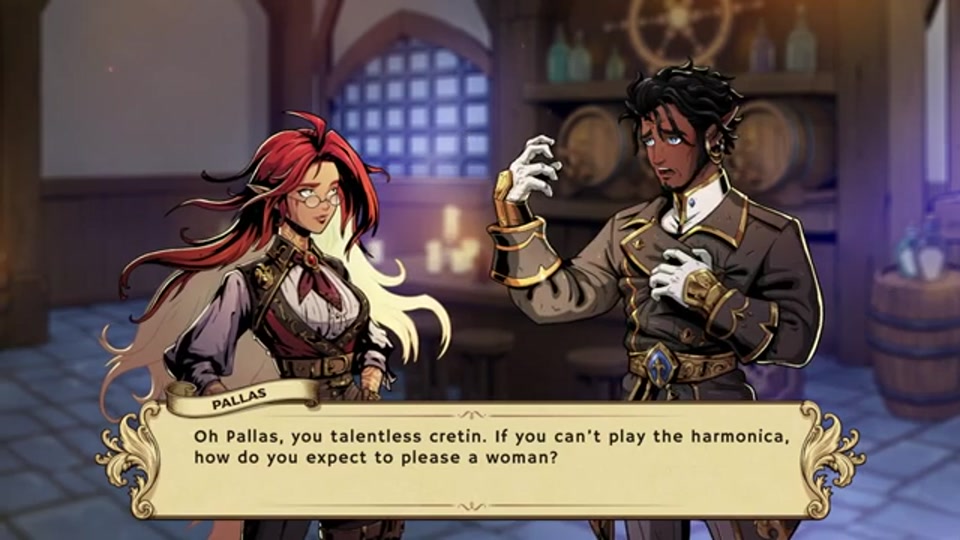
Ledgerbound’s hook is its tone: it takes the grandeur of a save-the-world fantasy RPG and runs it entirely through the machinery of a modern corporation. Here’s the setup, spoiler-free.
The world: Eldarra
Eldarra is a high-fantasy realm where corporate bureaucracy is the backbone of society. Magic isn’t just for wizards — it powers farm work, infrastructure, and the economy. Naturally, that means departments, shareholders, performance reviews, and HR. “Hero work” is simply another line of business, complete with the game’s running gag: Hero Insurance.
The premise
You play an insurance adjuster — a desk job — until an ancient threat collides with a performance review and you’re made a company-sponsored Hero. Reporting from the field puts the player character, Rayna, at the center of a catastrophe that no policy quite covers. The pitch sums it up neatly: defeat the forces of evil in the name of capitalism and… love.
You can read Rayna’s full profile on our companions & cast page.
The threat: the Vacari
The recurring antagonists are the Vacari, an immortal enemy that returns “deadlier” after every defeat. Mechanically that keeps you adapting; narratively it means the conflict escalates rather than resolving cleanly. Our Vacari enemy guide covers what to expect.
The history behind the bureaucracy
The public history gives Eldarra’s institutional language a deeper context. It says that the Myowans were the first to arrive on Eldarra after fleeing the Vacari and that other refugees later helped form civilization. The Myowans eventually unified Society under a Queendom. After a Caster Civil War, the Queendom established a Bureaucracy to restore order and peace of mind, developed procedures to standardize life, and created a Ministry of Paperwork to chronicle important matters.
These statements do not tell us every political conflict or current office rule. They do establish that paperwork and protocol are part of the world’s published history, not just a visual gag. A player can therefore enjoy an HR joke while noticing that institutions in Eldarra have roots in an attempt to manage conflict and uncertainty. For the detailed source-led version, see the Queendom and Ministry of Paperwork guide.
Magic, Casters, and the three moons
The official history says that Casters eventually provided basic needs such as food and shelter, helping Society enter an era of prosperity. It also says that scientists learned the cycles of Eldarra’s three moons and that eclipses guarantee powerful Casters are born. This presents magic as part of social history rather than a generic decoration. It does not establish an exact current character class, a player-facing calendar, or a universal combat rule.
Our Casters and three moons guide explains those public facts without converting them into invented mechanics. Treat a lore announcement as evidence for the history it states; use the current game text for a specific ability, mission, or character encounter.
Choices that matter
Ledgerbound emphasizes permanent decisions — “every decision you make, you are stuck with forever.” Expect a story that asks you to live with your calls, whether they’re tactical, corporate, or romantic.
Want the full picture of what’s confirmed? Head back to our Everything We Know hub.
Hy’oth, the Weft, and the ancient threat
The public history describes the Weft as a magical plane of unfettered power and identifies Hy’oth as a sinister force associated with it. It says Hy’oth can corrupt people by promising eternal power and can manipulate species to serve its aims. The same account connects the Vacari to Hy’oth and to the earliest published history of Eldarra’s arrivals.
That background gives the setting another scale beyond the workplace premise. It does not require a new player to know every later revelation. A source-conscious overview should identify the names and direct links, then leave the game room to show how its characters understand them. See Hy’oth and the Weft and Myowans and Eldarra’s founding history for separate, spoiler-conscious articles.
The player’s place in the setting
The insurance-adjuster premise matters because it puts an ordinary professional perspective at the center of this large history. The store description does not ask you to begin as a king, famous commander, or complete lore expert. It asks you to navigate a workplace-inflected world as an ancient enemy returns. Hero’s Insurance is described in the official history as a lucrative market for risky professions, which makes the premise’s vocabulary coherent even when it is funny.
This does not prove a full claims-management simulator, a specific promotion tree, or an outcome for a particular dialogue. It establishes tone and context. Our Hero’s Insurance guide explains how to keep that distinction clear when reading older previews and current game information.
Relationships, work, and tactical pressure
The launch material describes a blend of tactical RPG and dating sim, and the store text frames limited time as a choice between relationships and becoming a stronger tactician. The official romance announcement introduces a group of eligible characters. These statements support a setting where work, friendships, and danger overlap. They do not publish a universal relationship schedule, a correct dialogue answer, or an exhaustive route chart.
For a spoiler-light approach, start with the companions and romance guide and quest-life balance guide. Both distinguish a confirmed public premise from an unverified optimization claim.
How to use this page without spoiling yourself
Use this overview when you need the basic nouns: Eldarra, the Vacari, Hero’s Insurance, the Queendom, the Bureaucracy, Casters, the Weft, and Hy’oth. Then choose a more specific page only if you want that category of context. Do not search for an ending when you only need a definition, and do not treat a theory thread as a source because it sounds like it belongs in this world.
When a source is official, check its date and scope. A historical announcement can explain setting background; a current patch note can explain a live technical issue; the Steam store can explain the public product premise. Each type of source answers a different question. Keeping them apart is the best way to enjoy the game’s satire without replacing it with stale or fabricated information.
Bottom line
Ledgerbound’s setting is a corporate-fantasy Eldarra where an insurance adjuster faces an immortal ancient enemy amid institutions shaped by migration, conflict, magic, and bureaucracy. The official material already supplies a rich foundation. Read it as a starting map rather than a full spoiler guide, and let the released story reveal the individual people, decisions, and consequences that make the world matter.
Frequently Asked Questions
What is Ledgerbound about?
You play a fantasy insurance adjuster in Eldarra who is forced from a desk job into the role of a company-sponsored Hero when an ancient enemy, the Vacari, threatens the world.
What is the world of Ledgerbound called?
Eldarra. Official history describes a society shaped by refugee arrivals, a Queendom, a Bureaucracy, Casters, and an ancient Vacari threat; it does not make every magical or institutional detail a current game mechanic.