Systems Guide
Ledgerbound Combat System Explained: Elements, Sigils & the Grid
How Ledgerbound's turn-based tactical combat works — the Fire/Water/Plant rock-paper-scissors triangle, grid positioning, and Sigil tiles that buff or weaken your party.
Ledgerbound’s fights are short, sharp tactical puzzles played out on a grid. You won’t win by out-leveling everything — you win by reading the board. Here’s how the core systems fit together.
Turn-based stages on a grid
Encounters are stage-based: discrete, designed battles rather than open grinding. Heroes and enemies take turns moving across a grid, then attack or use special abilities. Because each stage is compact, positioning decisions carry real weight — a single wasted move can hand the enemy a free turn.
The element triangle: Fire, Water, Plant
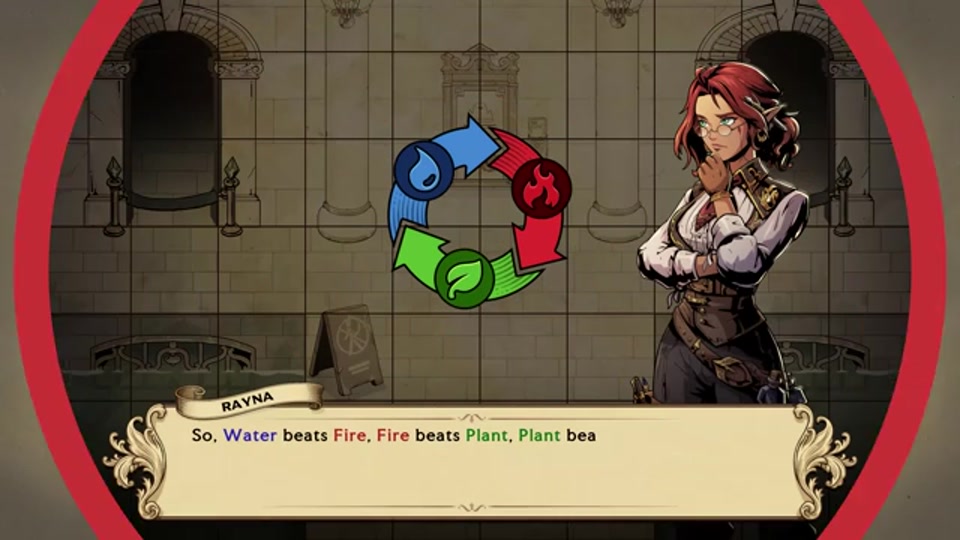
Every unit has an element, and that element decides how hard — and how accurately — its attacks land. The three form a classic rock-paper-scissors cycle:
| Element | Strong against | Weak against |
|---|---|---|
| 🔥 Fire | Plant | Water |
| 💧 Water | Fire | Plant |
| 🌿 Plant | Water | Fire |
Attacking into a favorable matchup means more damage and better accuracy; swinging into a bad one means whiffs and chip damage. Building a party with all three elements lets you always answer what the enemy brings.
Our interactive element & Sigil chart is a handy quick reference during a fight.
Sigils: the board has an element too
The grid isn’t neutral. Certain tiles are Sigils, and each Sigil carries an element. Stand a unit on a Sigil that matches its element and its stats go up; park it on the opposing element’s Sigil and its stats drop. That single rule creates most of the depth:
- A weaker unit on a friendly Sigil can beat a stronger unit caught on hostile ground.
- Forcing an enemy off its Sigil — or onto a bad one — is as good as a buff.
- Sometimes the best turn is moving, not attacking, to claim the right tile first.
Vouchers and gear feed back into combat
Completing optional objectives during a mission earns company vouchers, which you spend on corporate gear that boosts stats. That means combat, objectives, and your loadout form a loop: harder optional play → more vouchers → stronger gear → harder optional play. See our vouchers and corporate gear guide.
The Vacari scale with you
The recurring enemy faction, the Vacari, come back “deadlier” each time you beat them, which nudges you to keep adapting your lineup rather than leaning on one winning team forever. We cover their patterns in the Vacari enemy guide.
Quick beginner takeaways
- Cover all three elements in your party so you’re never hard-countered.
- Check the Sigil layout before you commit a unit to a tile.
- Treat optional objectives as your gear economy, not as side fluff.
- Don’t autopilot — every stage is a small puzzle with a clean solution.
New to the game? Pair this with our beginner tips.
Editorial verification and current-reading note
This page is part of the site’s dated coverage of combat system explained. It remains useful as a record of what was announced, shown, or discussed at the time it was published. It should not be used by itself as proof of present-day availability, balance, platform support, technical status, or a complete gameplay rule. Ledgerbound’s public record includes demo material, release announcements, and post-launch patch notes; each answers a different question and can supersede an earlier time-sensitive claim.
The first step for a reader is to identify the kind of information they need. The Steam store page is the appropriate place to check the live product description, listed requirements, language information, and regional availability. The newest official Steam news post is the appropriate place to check a patch, known issue, release update, or developer statement. A historic article such as this one is the appropriate place to understand the sequence of announcements or the context around a promotion. Mixing those three source types produces the misleading impression that all facts were published at the same time.
When an older sentence conflicts with a newer primary source, the newer source wins for a current decision. This does not mean the old article was worthless or should be silently rewritten as though it had predicted the future. It means the page should preserve its date and give readers a path to the current record. For example, a demo observation can explain why players first discussed a system, while a launch hotfix can explain what the developer later fixed or still lists as an issue. Both can be true in their own context.
Read specific claims at the scale the source supports. A cast announcement can confirm a performer-character pairing; it does not by itself publish a route guide. A store description can establish a genre and premise; it does not provide every tactical value. A patch note can identify a known issue; it does not guarantee a fix date. A review can describe a critic’s experience; it does not become a substitute for the current store or developer documentation. Keeping these boundaries visible is more useful than making an article sound definitive.
If you are making a purchase decision, check the live listing before relying on a historic headline. Compare the requirements with your actual Windows or macOS device, and read the newest patch note if a display mode, save issue, difficulty mode, or handheld status matters to you. If an official demo is currently available, it can be a useful test for that build, but it is not automatically a promise that every release feature will behave identically. Our PC requirements guide and release-date guide explain the current-check workflow in more detail.
If you are playing and encounter an apparent problem, separate a difficult tactical choice from a reproducible defect. Read the visible objective and current tooltips before assuming an encounter is broken. For a freeze, a reload loop, missing display option, or repeatable inconsistency, record the game version, platform, scene or battle, expected result, actual result, and steps. Then check the newest official patch information. The developer’s first launch hotfix includes a concrete Reset Battle instruction for a named battle-save issue; it is a safer model than deleting files or copying an unsupported workaround from a forum.
If you are researching characters or story, choose a spoiler boundary before asking for help. A narrow question about public information or a current visible choice can usually be answered without revealing an ending. A full route chart or a lore theory may contain material a first-time player did not intend to see. State your chapter, version, and desired level of detail. Good community advice names what it observed; it does not present a personal preference, a pre-release memory, or a repeated rumor as universal fact.
This verification note does not change the historical subject of the article. It makes the article safer to use after launch. The source links in the frontmatter are there so readers can inspect the underlying announcements themselves. When a later official source changes a time-sensitive fact, this site will add or link the correction rather than relying on an unsourced update. That is the standard applied to all current Ledgerbound coverage.
For broader source context, see how to verify Ledgerbound information, official announcements archive, and Patch #1 known issues. The goal is not to make readers research every sentence; it is to give them a reliable next step when a date, version, feature, or claim matters to their actual playthrough.
Frequently Asked Questions
What are the elements in Ledgerbound?
Units have one of three elements — Fire, Water, or Plant — arranged in a rock-paper-scissors triangle that affects the damage and accuracy of attacks.
What are Sigils?
Sigils are tiles on the battle grid that carry an element. A unit on a matching Sigil gets a stat boost; a unit on the opposing element's Sigil is weakened.
Is Ledgerbound combat hard?
It's designed around short, puzzle-like stages rather than long grinds. Reading enemy elements and using the grid well matters more than raw stats.